Understanding the Practical Value of Watercolor White Lily Flower Arrangement Clip Art
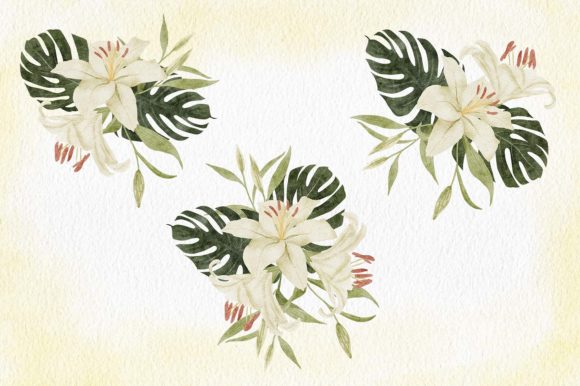
In digital creative work, the selection of visual assets is a foundational decision that impacts both the efficiency of a project and its final aesthetic quality. The Watercolor White Lily Flower Arrangement package, consisting of three hand-painted illustrations, represents a specific category of resource designed for integration into various media. This analysis examines its characteristics and practical utility from a professional standpoint.
Core Characteristics and Technical Specifications
The package is defined by its focused subject matter: three distinct illustrations of white lily arrangements rendered in a watercolor style. This medium is inherently associated with soft edges, translucent color layers, and a gentle, organic texture that digital vector art often cannot replicate authentically. Each illustration is provided in two common file formats, .JPG and .PNG, with the latter offering a transparent background capability that is critical for seamless compositing.
The resolution of 2000 pixels by 2000 pixels is a significant detail. This size ensures the assets are high-resolution, suitable for both digital display and many print applications at moderate scales without loss of clarity. It provides a practical balance, offering sufficient detail for close inspection while keeping file sizes manageable for standard design workflows.
Evaluating Usability and Project Integration
The primary strength of the Watercolor White Lily Flower Arrangement assets lies in their flexibility. The watercolor aesthetic is versatile, fitting contexts that require a softer, artistic, or elegant visual tone. Unlike hyper-realistic photography or rigid geometric graphics, these illustrations can complement branding for businesses in wellness, lifestyle, education, or creative services.
For example, a blogger focusing on mindfulness or natural living might use one of the lily elements as a recurring visual motif in post headers or social media graphics. An entrepreneur creating wedding invitation templates could employ the transparent PNG files to layer florals over text and backgrounds. The consistency across the three illustrations—sharing a common style and color palette—means they can be used together to create a cohesive set of icons or decorative elements without the designer needing to adjust color balance or style manually.
Audience Fit and Practical Applications
The value of this resource is not universal; it is aligned with specific user profiles and project requirements. Professionals, marketers, and content creators who regularly produce digital materials and lack the time or skill to create custom illustrations from scratch are a key audience. For them, such a package solves a practical problem: obtaining a ready-made, stylistically consistent visual component.
Freelancers often work on projects with constrained budgets where commissioning original art is not feasible. A well-executed clip art package becomes a reliable, cost-effective element in their asset library. Educators designing course materials or presentations may find the gentle watercolor style more engaging and less corporate than standard clip art, suitable for topics related to botany, art, or literature.
A possible limitation is style specificity. The Watercolor White Lily Flower Arrangement carries a distinct mood. Projects demanding a bold, minimalist, or tech-oriented look would not benefit from its inclusion. Its utility is highest when the project’s visual direction already aligns with or can accommodate an organic, painterly element.
Quality Considerations and Long-Term Value
From a quality perspective, the merits of hand-painted digital illustrations include unique brush strokes and color variations that prevent a sterile, repetitive appearance. When evaluating such assets, one considers whether the texture and detail hold up under zooming and whether the color palette is harmonious and usable without correction. The described high resolution suggests the artwork should maintain integrity when used at typical sizes.
Reliability in this context refers to file readiness. The provision of both JPG and PNG formats addresses different use cases, demonstrating thoughtful preparation by the asset creator. This small detail reduces the friction of implementation, as the designer does not need to perform format conversions.
The long-term value for a user depends on integration into a personal or organizational asset library. A single project use might justify acquisition, but recurring value comes from the ability to repurpose these lilies across multiple, disparate projects over time, maintaining a thread of visual identity for a creator or brand. Their non-seasonal and classic subject matter (white lilies) supports this repeated use better than very niche or trendy imagery.
Strengths in Presentation and Effectiveness
In final presentation, the effectiveness of watercolor clip art hinges on composition. These lily arrangements, by virtue of being isolated illustrations, give the designer control over placement, scaling, and layering. They can serve as focal points or subtle background accents. Their artistic style can elevate the perceived craftsmanship of a digital product, such as an ebook cover or website header, suggesting a human touch in an otherwise digital environment.
For marketing materials targeting an audience valuing aesthetics and artistry, such as in the boutique, creative, or luxury sectors, this subtle signaling can be beneficial. It avoids the generic feel of stock photography that viewers might recognize from other contexts.
Real-World Performance and Recommendations
In practical workflow, assets like the Watercolor White Lily Flower Arrangement perform as modular components. Their performance is judged by how quickly and cleanly they can be dragged into a layout software like Adobe Photoshop, Canva, or a presentation tool, and how well they blend with other design elements. The transparency of the PNG files is crucial here, allowing for non-destructive placement over colored backgrounds or text blocks.
A professional observation is to consider the surrounding design. To maximize impact, pair these illustrations with complementary typography and color schemes—perhaps soft serif fonts and muted background colors—that enhance the watercolor feel rather than clash with it. Avoid placing them atop busy, high-contrast patterns that would obscure their delicate details.
For those assessing whether this package fits their needs, a practical recommendation is to inventory recent and upcoming projects. If multiple projects have a visual tone that leans towards elegant, natural, artistic, or soft, then acquiring a set of consistent floral illustrations is a sensible investment. If your work is predominantly technical, data-driven, or requires a stark modern aesthetic, this resource may remain unused. The decision should be driven by alignment with ongoing creative demands, not by the appeal of the asset in isolation.
Ultimately, the Watercolor White Lily Flower Arrangement clip art package is a specialized tool. Its worth is not inherent but contextual, defined by the frequency and nature of the projects it will serve. For the right user—one whose creative output regularly calls for a touch of organic artistry—it provides a reliable, high-quality visual solution that can streamline production and enhance visual consistency across a body of work.